


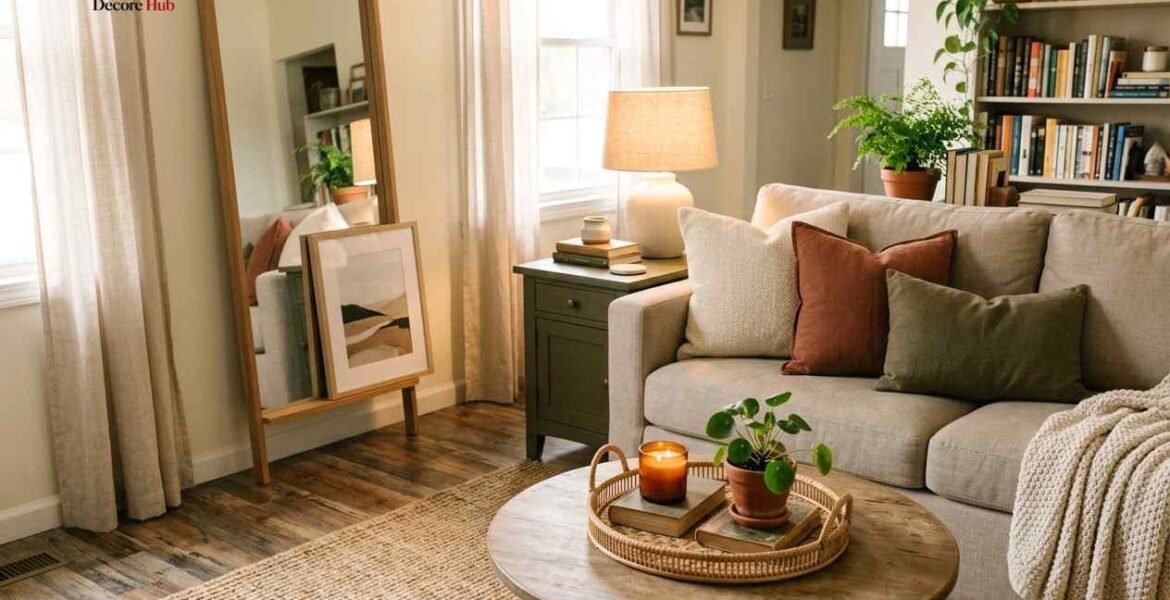
Budget Home Decor Ideas: 30 Ways to Decorate Your Home for Less
The cheapest budget home decor ideas cost nothing: shop your own home, rearrange the furniture, clear your surfaces, and group decor in odd numbers. After that, a few inexpensive swaps like pillow covers, a lamp, a plant, and a thrifted mirror do most of the remaining work. This guide gives you 30 ideas, each with a typical cost and a note on whether it’s safe for a rental, so you can pick what fits your budget instead of scrolling past ideas you can’t use.
Most advice about decorating on a budget starts with “use what you have” and stops there. These home decorating ideas on a budget start there too, then keep going in order, from free to roughly fifty dollars and beyond. If you’ve been searching for cheap home decor ideas that don’t look cheap, or low cost decorating ideas you can try in a rental, you’ll find both here. Costs are typical US ballparks and will vary by store and region.
Budget Home Decor Ideas at a Glance
Here are all 30 ideas with typical costs. Each one is explained in detail below.
| # | Idea | Typical Cost | Renter-Safe? |
| 1 | Shop your home first | Free | Yes |
| 2 | Rearrange your furniture | Free | Yes |
| 3 | Declutter and edit every surface | Free | Yes |
| 4 | Group decor in odd numbers | Free | Yes |
| 5 | Style one vignette with what you own | Free | Yes |
| 6 | Hang curtains higher and wider | Free to $15 | Small holes, ask first |
| 7 | Swap pillow covers and add a throw | $5 to $20 | Yes |
| 8 | Bring in flowers or branches | Free to $10 | Yes |
| 9 | Add a plant, real or faux | $3 to $15 | Yes |
| 10 | Group candles at different heights | $1 to $10 | Yes |
| 11 | Use baskets and trays | $5 to $20 | Yes |
| 12 | Replace a lampshade | $8 to $20 | Yes |
| 13 | Paint one accent wall | $30 to $60 | Ask first |
| 14 | Try stripes, stencils, or an ombre wall | $30 to $70 | Ask first |
| 15 | Paint old furniture | $10 to $40 | Yes |
| 16 | Update hardware | $10 to $40 | Yes, keep the originals |
| 17 | Use peel-and-stick wallpaper in small spots | $20 to $60 | Usually, test a patch |
| 18 | Spray paint frames, mirrors, and accessories | $5 to $15 | Yes |
| 19 | Build a gallery wall from thrifted frames | $10 to $30 | Yes, with strips |
| 20 | Hang a large mirror | $15 to $50 secondhand | Yes, lean it |
| 21 | Frame fabric, swatches, or free printables | $5 to $20 | Yes |
| 22 | Display plates on the wall | $5 to $20 | Yes, adhesive hangers |
| 23 | Style floating shelves and shadow boxes | $10 to $40 | Ask first |
| 24 | Lean art instead of hanging it | Free to $20 | Yes |
| 25 | Add a lamp and turn off the overhead light | $15 to $40 | Yes |
| 26 | String lights | $5 to $15 | Yes |
| 27 | Layer in texture | $10 to $50 | Yes |
| 28 | Shop thrift stores, estate sales, and auctions | Varies | Yes |
| 29 | Repurpose household items | Free to $10 | Yes |
| 30 | Sell what you don’t love and decorate slowly | Pays for itself | Yes |
Where to Start: Match Ideas to Your Budget
You don’t have to do all 30. Pick the row that matches what you can spend this month, and treat the rest as affordable decorating ideas to come back to.
| Your Budget | What to Do | Ideas |
| $0 | A free reset in one afternoon | 1 to 6 |
| About $25 | Add soft layers and something living | 7, 8, 11, plus the free ideas |
| About $50 | Change the lighting and add a mirror | 12, 20, 25 |
| About $100 | One bigger change | 13 or 16, plus 19 |
Do the free ideas first even if you have more to spend. They show you what the room is actually missing, and that stops you from buying things it didn’t need.
Free Budget Home Decor Ideas
1. Shop Your Home First

Typical cost: Free. Renter-safe: Yes.
Before you buy anything, walk through your home with one question: what here would look better somewhere else? A lamp from the spare room, a basket from the bedroom, a pillow from a chair nobody sits in. Move three things into the room you’re working on and restyle one surface using only those. It sounds too simple, but this is how most budget rooms actually get fixed. Family counts too. Hand-me-down furniture often needs nothing more than a coat of paint to fit your style (see idea 15).
2. Rearrange Your Furniture
Typical cost: Free. Renter-safe: Yes.
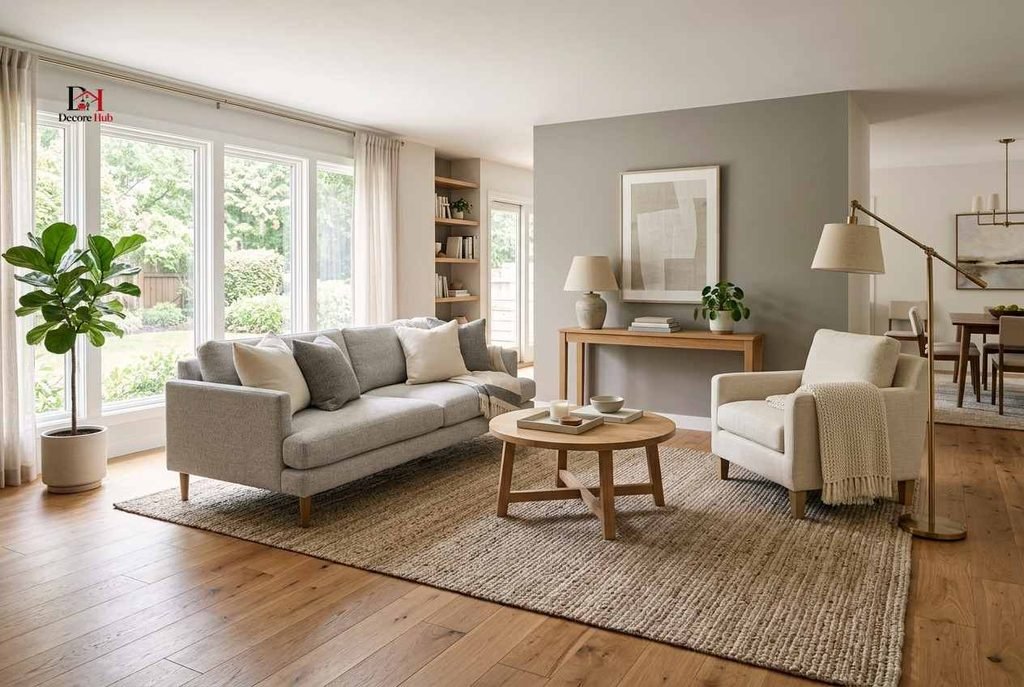
Our eyes stop noticing a layout after a few months, which is why a room can feel tired even when nothing is wrong with it. Angle the sofa, pull it a few inches off the wall, swap which wall the TV sits on, or turn the bed to face a different direction. Float pieces to build a clear conversation area instead of lining everything against the walls. Live with the new layout for a full day before you decide. The best arrangement usually shows itself in the evening.
3. Declutter and Edit Every Surface
Typical cost: Free. Renter-safe: Yes.
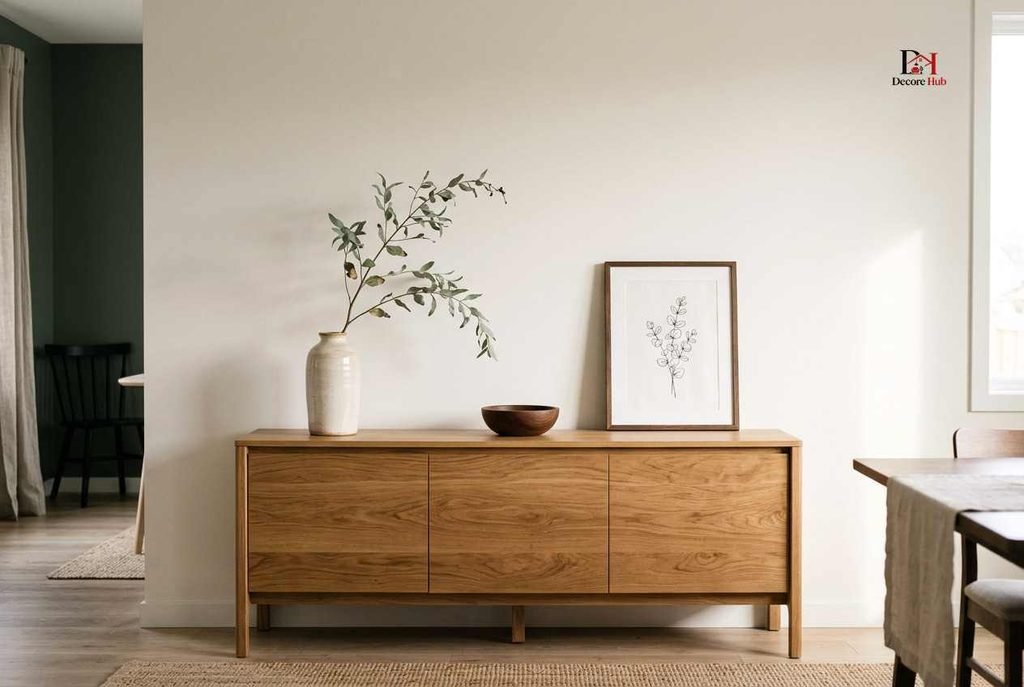
A cluttered surface makes even beautiful things look cheap. Clear one shelf or table completely, then add back only what earns its place, one item at a time. Stop when the surface looks calm, not when it looks full. If a few things don’t fit the room, that’s useful information, not a reason to keep them out. Honestly, this one idea fixes more rooms than any purchase on this list.
4. Group Decor in Odd Numbers
Typical cost: Free. Renter-safe: Yes.
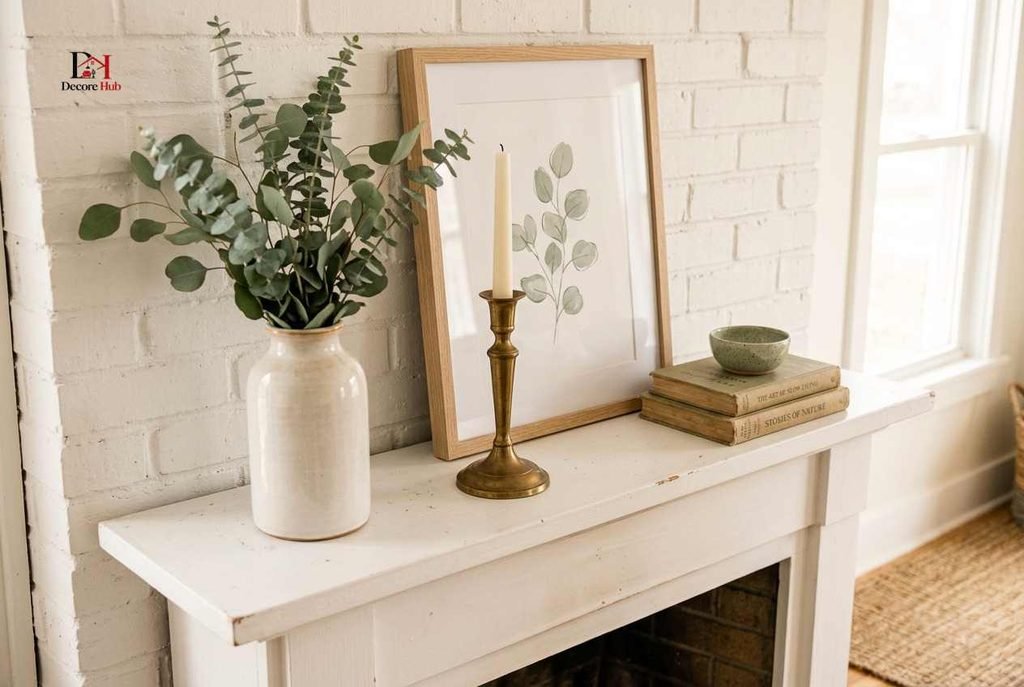
Groups of three or five look more natural than pairs and fours. On a mantel, shelf, or dresser, pair something tall like a vase with something medium like a lamp or frame and something small like a bowl or candle. Two lamps plus one arrangement also works, because the lamps read as a single set. If you have a lot of small things, gather them on a tray so they count as one object instead of five.
5. Style One Vignette With What You Own
Typical cost: Free. Renter-safe: Yes.
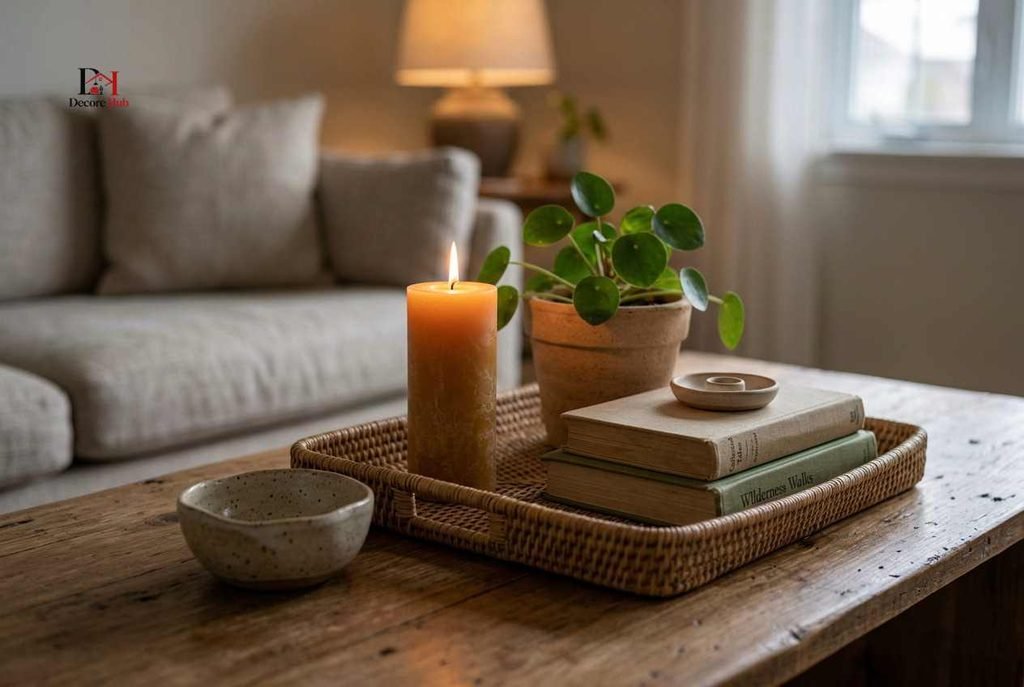
A vignette is a small, deliberate arrangement that gives the eye somewhere to land. Think of a tray with a candle, a small plant, and two stacked books on a coffee table, or a framed print leaning behind a ceramic jug on a dresser. Use what you own, vary the heights, add one natural element like a branch or a plant, and leave some empty space around it. Refresh it each season by swapping one or two pieces instead of starting over.
6. Hang Curtains Higher and Wider
Typical cost: Free to $15. Renter-safe: Small holes, ask first.
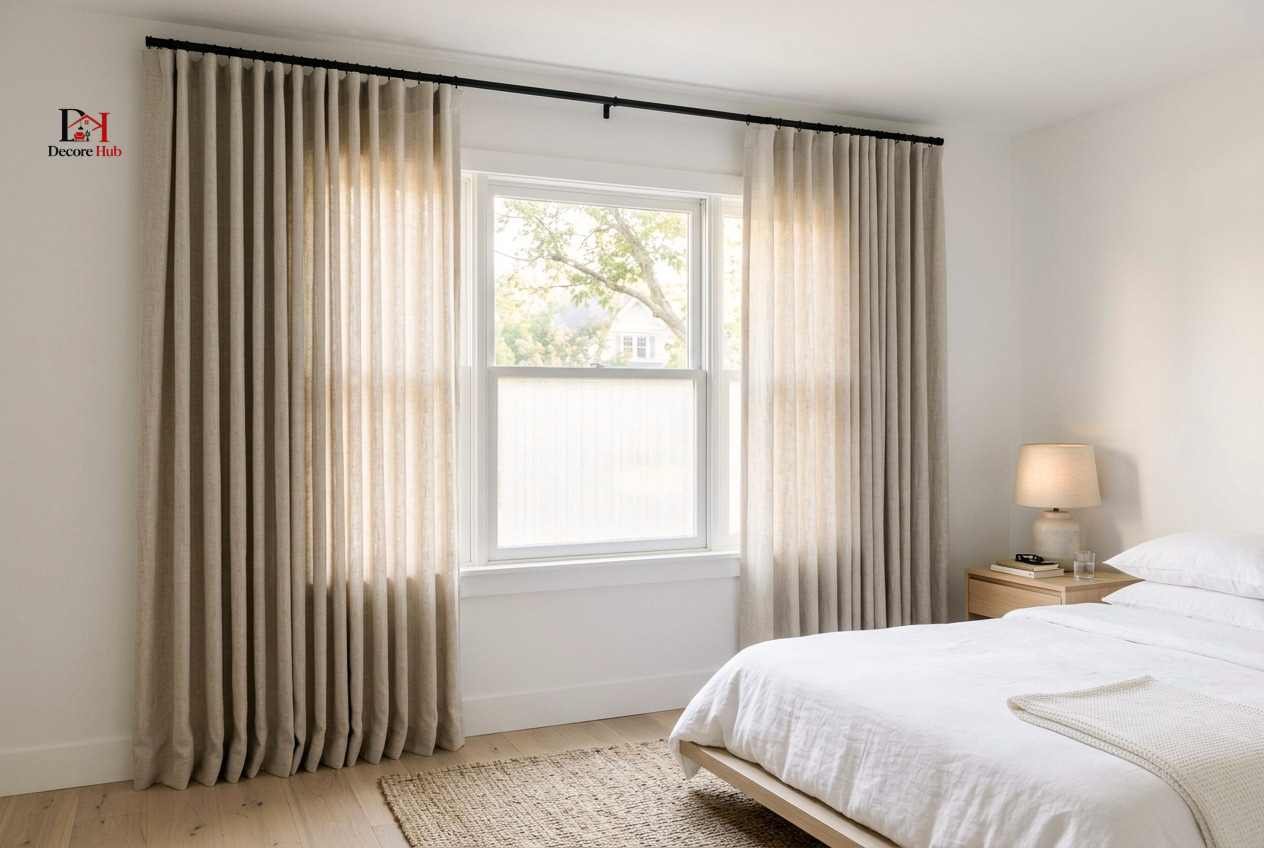
Mount the rod closer to the ceiling than to the window frame and let it extend several inches past each side of the window. The curtains then frame the wall instead of the glass, which makes the window look taller and wider and the whole room feel bigger. Floor-length panels work best. If you already own a rod, the cost is a few screws and ten minutes. Renters should know it means new holes, so ask first or plan to patch them when you move out.
Cheap Home Decor Ideas Under $20
7. Swap Pillow Covers and Add a Throw
Typical cost: $5 to $20. Renter-safe: Yes.
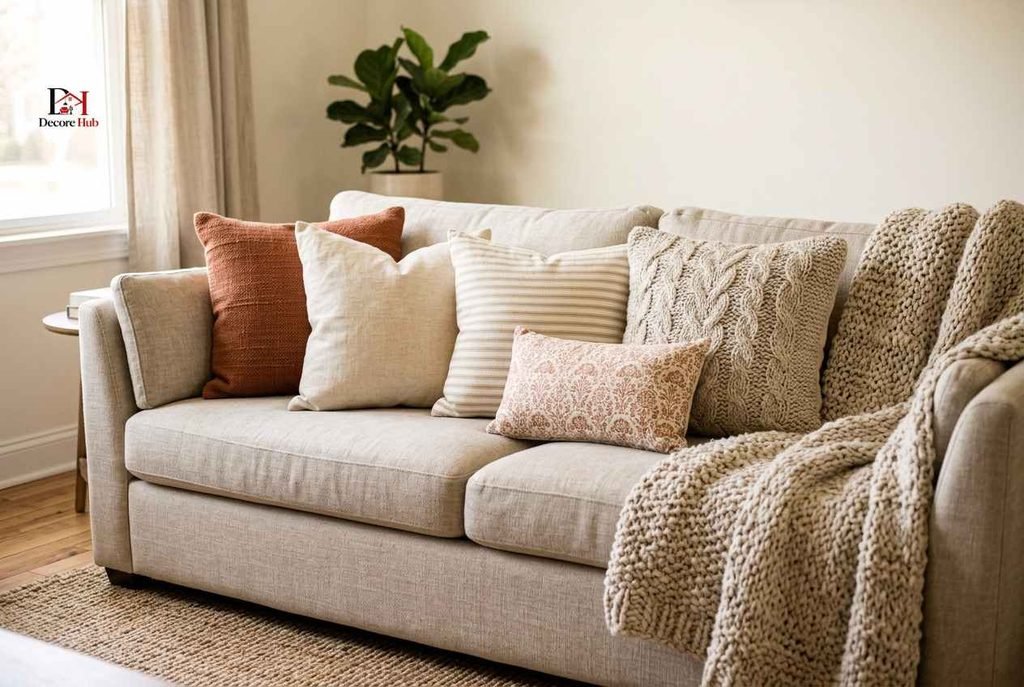
Covers cost less than new pillows and fold flat in storage, so you can rotate them through the year while keeping the inserts you already own. Mix one solid, one textured, and one pattern, and use an odd number on a sofa, three or five. A throw folded over a chair arm or the foot of a bed adds color and a soft layer. If you sew even a little, a simple envelope cover takes a few minutes, and fabric remnants are cheap.
8. Bring in Flowers or Branches

Typical cost: Free to $10. Renter-safe: Yes.
Fresh stems are the fastest way to make a room look cared for. A grocery store bouquet in a thrifted pitcher, a few branches clipped from your own yard, or a single stem in a bottle all work. If you want something that lasts, buy one or two good faux stems on sale instead of one big arrangement. They get used for years, and a handful of nice stems goes further than a bunch of cheap ones.
9. Add a Plant, Real or Faux
Typical cost: $3 to $15. Renter-safe: Yes.
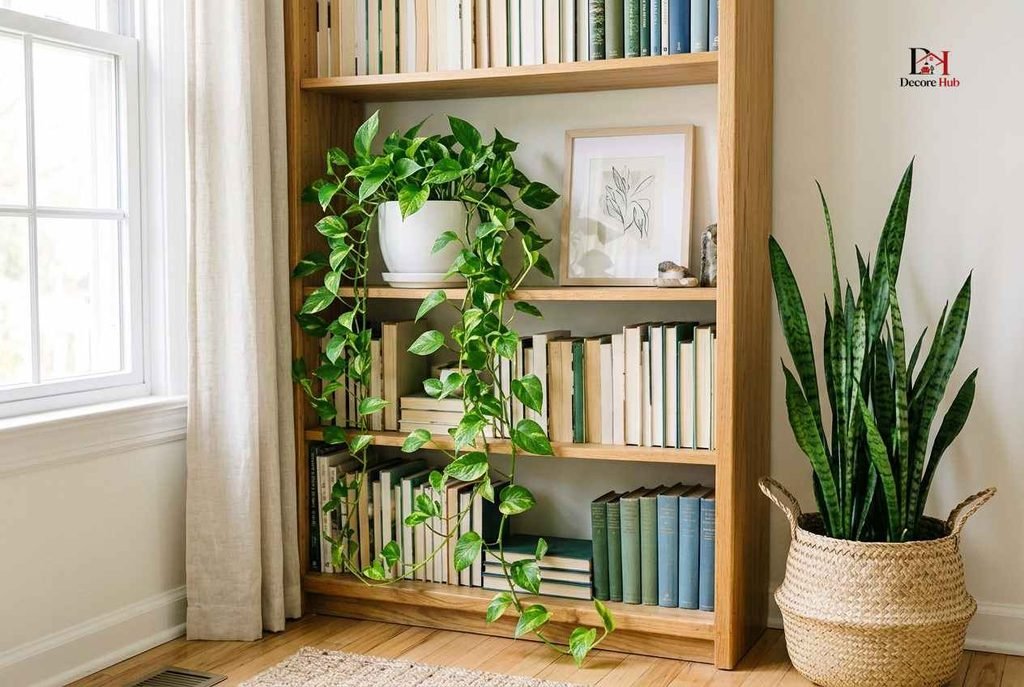
Something alive adds color and softness that no accessory matches. A pothos is forgiving, trails nicely from a shelf, and costs a few dollars as a cutting or small pot. A snake plant handles low light. Put a taller plant in an empty corner and a smaller one on a table. If you can’t keep plants alive, a realistic faux plant in a nice pot does the same job and never needs watering.
10. Group Candles at Different Heights

Typical cost: $1 to $10. Renter-safe: Yes.
Three or five pillar candles at different heights look considered instead of cheap. Group them on a tray, hearth, or table, and lift one or two on a wood coaster or small riser so the heights vary. Battery candles are fine, especially if you have pets or little surface space. What matters is the glow and the grouping, not what the candles cost.
11. Use Baskets and Trays

Typical cost: $5 to $20. Renter-safe: Yes.
Baskets and trays are the hardest-working budget pieces because they decorate and organize at once. A basket holds blankets, magazines, or toys while adding natural texture. A tray gathers loose items on a coffee table, dresser, or kitchen counter so a messy surface becomes a styled one. Thrift stores are full of both. If a room feels flat, add texture here before you buy more decor.
12. Replace a Lampshade

Typical cost: $8 to $20. Renter-safe: Yes.
A dated or stained shade can make a perfectly good lamp look old. Swapping it for a clean linen drum shade, or one in a color that suits your room, is an inexpensive, instant update. Check the type of fitter (the part that attaches the shade) and the size before you buy, and bring the lamp with you if you can.
Decorating on a Budget With Paint, Wallpaper, and Hardware
13. Paint One Accent Wall

Typical cost: $30 to $60. Renter-safe: Ask first.
Paint is the cheapest large-scale change you can make. Home Depot notes that one gallon of interior paint can cover up to about 400 square feet, which is far more than one accent wall needs, so a quart or sample size is often enough. Pick the wall behind your bed or sofa and go a few shades deeper than the rest of the room. If you rent, get written permission first. If you can’t paint, jump to idea 17.
14. Try Stripes, Stencils, or an Ombre Wall

Typical cost: $30 to $70. Renter-safe: Ask first.
If a plain accent wall feels too basic, paint can do more. For stripes, section the wall with painter’s tape, paint between the lines in an accent color, and peel the tape once it dries. For a stencil, trace a shape onto cardboard, cut it out, and repeat it across the wall. For an ombre, use three shades of one color: the lightest over the whole wall, the middle shade on the bottom two thirds, and the darkest on the bottom third. All three need patience more than skill.
15. Paint Old Furniture

Typical cost: $10 to $40. Renter-safe: Yes, it’s your furniture.
A coat of paint can turn a dated thrifted dresser, a hand-me-down chair, or a wobbly side table into the piece that anchors the room. Clean it, sand it lightly, prime if the surface is glossy, and use a paint made for furniture. Even upholstery can be painted with the right technique, though test a hidden spot first. For something smaller, paint only the legs of a sofa or chair to add a quiet pop of color.
16. Update Hardware With New Pulls or Spray Paint

Typical cost: $10 to $40. Renter-safe: Yes, keep the originals.
New knobs and pulls make a dresser or kitchen look updated for a few dollars a piece. If the originals are in decent shape, spray paint them instead: remove them, set them on cardboard in a ventilated space, sand wooden ones lightly, apply a spray primer, then finish with one or two thin coats of paint. Renters should keep the original hardware in a labeled bag and swap it back before moving out.
17. Use Peel-and-Stick Wallpaper in Small Spots

Typical cost: $20 to $60. Renter-safe: Usually, test a patch first.
Wallpaper gets expensive over a whole room, but a small area costs little. Use it behind open shelving, inside a niche, as a strip backsplash, on the front of a bookcase, or as a square behind the bed that mimics an upholstered headboard. Peel-and-stick versions are friendlier to renters, though adhesion varies by paint type, so test a hidden patch first.
18. Spray Paint Frames, Mirrors, and Accessories

Typical cost: $5 to $15. Renter-safe: Yes.
DIY home decor on a budget often starts with a can of spray paint, which is the best money-for-impact item in a budget decorator’s kit. Old frames, dated mirrors, clocks, a brass lamp base, and plastic planters all look new in a single color, whether that’s matte black, gold, or white. Work outdoors or somewhere well ventilated, use thin coats, and let each dry before the next. Painting a mismatched set the same color is also the quickest way to make thrifted pieces look like a collection.
Inexpensive Home Decor Ideas for Your Walls
19. Build a Gallery Wall From Thrifted Frames

Typical cost: $10 to $30. Renter-safe: Yes, with adhesive strips.
Buy mismatched frames at thrift stores or yard sales for a few dollars each, then paint them all one color so they read as a collection. Fill them with your own photos, free printable art, or inexpensive prints. Before hanging anything, cut paper templates, tape them to the wall, and shuffle them until the layout works, leaving two to three inches between frames. Adhesive strips hold lightweight frames in a rental.
20. Hang a Large Mirror

Typical cost: $15 to $50 secondhand. Renter-safe: Yes, lean it.
A big mirror is decor and a room enlarger in one. Place it across from a window so it bounces daylight around, or lean a floor mirror against the wall so you don’t need any hardware. Secondhand mirrors are everywhere, and dated frames are easy to repaint. A cluster of small mirrors in different shapes can also stand in for a gallery wall.
21. Frame Fabric, Swatches, or Free Printables

Typical cost: $5 to $20. Renter-safe: Yes.
Art doesn’t have to be art. A fabric swatch, a patterned dish towel, a piece of wallpaper, a favorite scarf, or a free printable looks intentional inside a frame with a wide mat. Even a worn graphic T-shirt with a great design can be framed. Group two or three in matching frames and you have a pattern-forward wall for almost nothing.
22. Display Plates on the Wall

Typical cost: $5 to $20. Renter-safe: Yes, with adhesive hangers.
Unused decorative plates, thrifted china, or ceramic dishes look great on a wall the way framed art does. Use wire spring plate hangers, or adhesive disc hangers for lighter plates. Cluster them around a mirror or in a symmetrical grid, and keep to one color family, like blue and white, so the mix of sizes feels intentional.
23. Style Floating Shelves and Shadow Boxes

Typical cost: $10 to $40. Renter-safe: Ask first, since they need drilling.
Think of floating shelves as an installation, not just storage: a few wood shelves placed in an arrangement that still looks good half empty. Style them with books, a small plant, a ceramic piece, and one frame, and leave gaps. Shadow boxes, store-bought or made from a deep frame, are a good way to display small collections or keepsakes.
24. Lean Art Instead of Hanging It

Typical cost: Free to $20. Renter-safe: Yes.
Leaning a large frame or canvas on a dresser, console, or the floor skips the hardware completely, and it looks relaxed on purpose. Layer a smaller frame or a mirror in front, and put a plant or lamp nearby. It also means you can change the art in seconds without patching anything.
Low Cost Decorating Ideas: Lighting, Texture, and Thrifted Finds
25. Add a Lamp and Turn Off the Overhead Light

Typical cost: $15 to $40. Renter-safe: Yes.
If we could add one thing to almost every room, it would be a lamp. A single overhead light flattens a room, while two or three lamps at different heights create warm pools of light that make the same space feel richer. Thrifted lamps are cheap, and a new shade (idea 12) updates them. In the evening, turn the ceiling light off and let the lamps do the work.
26. Add String Lights

Typical cost: $5 to $15. Renter-safe: Yes.
Battery-powered string lights are easy to add behind a headboard, along a shelf, around a mirror, or in a window, and they need no outlet. Choose warm white over cool white or multicolor, which tends to look cheaper. They store flat and last for years.
27. Layer in Texture

Typical cost: $10 to $50. Renter-safe: Yes.
When a neutral or budget room feels flat, texture is usually the missing piece. Add a natural-fiber rug, a wooden stool or tray, a linen curtain, a woven basket, a wool or knit throw, and a ceramic piece with a rough glaze. Pick three or four textures and repeat each at least twice around the room so it reads as a plan instead of a pile.
28. Shop Thrift Stores, Estate Sales, and Auctions

Typical cost: Varies. Renter-safe: Yes.
This is where budget decorating gets its personality. Goodwill, The Salvation Army, Habitat for Humanity ReStores, yard and estate sales, auction houses, and Facebook Marketplace all carry furniture and decor for a fraction of retail. On Marketplace, search for words like vintage or antique and for brand names you like. Look for solid wood furniture, which is often sturdier than new budget pieces, along with brass candlesticks, hardcover books, frames, glassware, lamps, and baskets. IKEA is another good source of plain basics you can paint. Measure before you go, and give yourself a one-item limit on impulse buys.
29. Repurpose Household Items

Typical cost: Free to $10. Renter-safe: Yes.
Plenty of what you already own can be decor. A clean glass jar becomes a vase or a candle holder, filled partway with sand or pebbles and a tealight. Wrap a jar in sisal rope with a glue gun for a rustic vase. A spare cabinet door can serve as a tray, and old drawers can be mounted on a wall as shelves. Before you toss anything, ask what it would look like in a different room.
30. Sell What You Don’t Love and Decorate Slowly

Typical cost: Pays for itself. Renter-safe: Yes.
If a piece no longer fits your style, list it on Marketplace and put the money toward what you actually want. Plenty of people upgrade a dining set or a sofa this way at close to zero net cost. Then slow down. Decorating a room over a few weeks, one piece at a time, costs less and looks better than trying to finish it in one shopping trip, because you only buy what the room has shown it needs.
Budget Home Decorating Mistakes to Avoid
Buying lots of small accessories. A few larger pieces look better than a room full of knickknacks, and often cost less in total.
Following every trend. Trendy items date quickly. Put your money into pieces you’ll still like in three years and use cheap swaps for trends.
Filling every empty space. Empty space isn’t a problem to solve. It’s what lets the styled areas stand out.
Shopping before you plan. Measure the space, write down what the room needs, and rank it. Without a list, it’s easy to overspend on items that don’t matter.
Ignoring scale. A tiny rug or small art on a big wall looks cheap no matter what it cost.
Painting a rental without permission. Skip the walls unless you have it in writing, and use peel-and-stick, lamps, textiles, and leaning art instead.
How to Keep Costs Down When You Shop
Budget friendly home decor works best when you buy fewer, better things. Measure before you buy, especially mirrors, rugs, and curtains, because returning something large is a hassle. When buying online, check the return policy and read reviews before you commit. Spend a little more on the pieces you’ll use every day, like a good lamp or a solid mirror, and save on the things that are easy to swap, like pillow covers and vases. And if you can wait for a sale, wait.
Where to Go From Here
Once you’ve picked a few ideas, the rest of the budget guides go deeper. For the step-by-step process of how to decorate on a budget, including how to set a number and rank what you need, the planning guide covers it. The guide to making your home look expensive on a budget covers lighting, curtains, and details that read as high-end, and the under-ten-dollar guide has the cheapest finds. For specific rooms, the living room and kitchen budget guides walk through each one. If you rent, the small apartment guide covers layout, storage, and renter-safe changes in more detail, and the full home decor ideas guide ties everything together by room.
Save this list for your next free weekend.
Frequently Asked Questions About Budget Home Decor
1. What Is the Cheapest Way to Decorate a Home?
The cheapest way to decorate a home is to use what you already own. Move decor between rooms, rearrange furniture, declutter surfaces, and group decorative items in odd numbers. These free changes can make a room feel more organized, balanced, and complete.
2. How Can I Decorate My House With No Money?
Shop your own home, rearrange furniture, and restyle shelves or tables using items you already have. You can also borrow decor from family, reuse old furniture, or add branches and greenery from your yard to bring a fresh look to your space.
3. What Should I Buy First When Decorating on a Budget?
A lamp is a great first purchase because good lighting can transform a room without requiring a major makeover. After that, consider affordable pillow covers, a large mirror, or a plant. These simple additions can make your space feel more inviting without spending too much.
4. How Much Should I Spend to Refresh a Room?
Your budget depends on how much you want to change. A free refresh can involve rearranging furniture and decluttering, while a light makeover with a lamp and soft furnishings may cost $25 to $50. For a bigger update involving paint, new hardware, and a gallery wall, you might spend around $100. Start with free improvements and purchase only what your room needs.
5. How Do I Make My Home Look Expensive on a Budget?
To make your home look expensive on a budget, declutter, layer your lighting, hang curtains closer to the ceiling, and incorporate different textures. Choose one statement piece instead of filling the room with small accessories. Mixing thrifted finds with a few carefully selected new items can also create a stylish, collected look.
6. How Can Renters Decorate on a Budget?
Renters can decorate affordably with peel-and-stick wallpaper, freestanding mirrors, leaning artwork, new pillow covers, and decorative lamps. Plants and removable accessories can also add personality without permanent changes. If you plan to replace hardware, keep the original pieces, and always check your lease or ask your landlord before painting or drilling.
7. Where Can I Buy Cheap Home Decor?
Affordable home decor is available at thrift stores, Habitat for Humanity ReStores, estate sales, auctions, and Facebook Marketplace. For new items, stores such as IKEA, Target, HomeGoods, and dollar stores offer budget-friendly options. Compare prices, check item quality, and look for secondhand pieces before buying everything new.
8. Is Thrifted Decor Better Than Cheap New Decor?
Thrifted decor can offer better quality and more character, especially when shopping for solid wood furniture, metal accessories, and glass pieces. However, quality varies, so inspect secondhand items before purchasing. Cheap new decor is often a practical choice for replaceable accessories, such as pillow covers, candles, and seasonal decorations.
9. Is It Okay to Decorate a Room Slowly?
Yes, decorating a room gradually is an excellent way to stay within your budget. Start with the essentials, live with your updated space, and identify what is still missing before buying more. This approach helps you avoid unnecessary purchases and build a home that reflects your personal style over time.
